

Disclosure: we may earn a commission from qualifying purchases through some links on this page, at no extra cost to you. We only recommend products that fit the job.
General information, not legal or tax advice. Raffle rules are set by each state; check with your state's charitable gaming regulator. Federal rules checked against the IRS Instructions for Form W-2G (Rev. 01/2026) and IRS Publication 3079 on November 2026.
How to run a 50/50 raffle, in short: sell numbered tickets, pool the money, draw one ticket, and pay half the pot to the winner while your cause keeps the other half. Buyers fund the prize, so it costs you nothing. The work is in the setup: check your state's rules, write simple rules, control the cash, and draw in public.
Quick answer
How do you run a 50/50 raffle?
Confirm your state allows it and get any permit. Write rules covering price, split, cut-off time and how winners are paid. Sell numbered double tickets, keeping one half in a sealed container. At the cut-off, two volunteers count the pot, announce it, draw one stub publicly and pay the winner half.
How a 50/50 pot works
The prize grows with every sale, which is the whole appeal. Here is the split at different sales levels.
| Tickets sold at $5 | Total pot | Winner's half | Your cause's half |
|---|---|---|---|
| 100 | $500 | $250 | $250 |
| 400 | $2,000 | $1,000 | $1,000 |
| 1,000 | $5,000 | $2,500 | $2,500 |
| 2,500 | $12,500 | $6,250 | $6,250 |

Step 1: Check your state's rules first
A 50/50 is a cash-prize raffle, regulated by state law. Some states ban charitable raffles, some require a license for each event, and some restrict cash prizes or who can sell tickets. Your state's charitable gaming regulator, attorney general or secretary of state is the place to check.
Some states treat 50/50s as their own category. New Jersey's Legalized Games of Chance Control Commission, for example, lists separate licenses for on-premises and off-premises 50/50 raffles. Its on-premises fee is $20 per drawing day when the anticipated prize exceeds $400, and there is no license fee below that. School groups and churches should also check district or diocesan policy; see whether a PTO can do a raffle.
How to run a 50/50 raffle at your event
- Pick the split and write the rules. Decide the winner's share, the cut-off time, who may buy, and how an absent winner is paid.
- Get double-roll tickets. Each ticket has two matching halves: the buyer keeps one, the other goes into a sealed container. Store-bought double-roll raffle tickets are fine for most events. See what to put on a raffle ticket if you print your own.
- Equip your sellers. Give each seller a roll, a float of small bills and an apron or pouch. Log each seller's starting ticket number and float.
- Sell and update the pot. Announce the running total at breaks; a rising number sells tickets.
- Stop at the cut-off. Sellers return rolls, cash and stubs together, with the last number sold.
- Count with two people. Count the cash, subtract floats, and check the total against tickets sold. Both counters sign the count sheet.
- Announce, then draw. State the pot and the winner's share, mix the stubs, and have a neutral person draw in full view.
- Pay and record. Pay by check where you can, collect any tax information needed, and keep the count sheet and stubs.
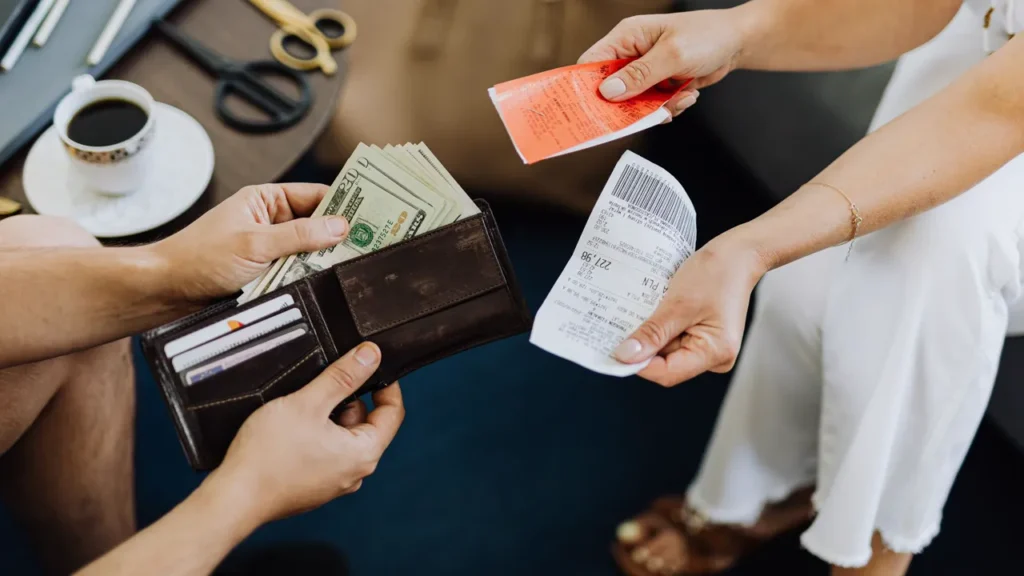
The drawing is where trust is won or lost. For mixing, witnesses and absent winners, see our guide on how to do a raffle drawing.
Splits, multiple winners and online 50/50s
"50/50" is a name, not a rule. Many groups use 60/40 or 70/30 in favor of the cause, or split the winner's share among several winners. Print your split in the rules before the first sale. For a format where tickets are eliminated one by one, see how a reverse raffle works.
| Format | How the pot splits | Best for | Watch out for |
|---|---|---|---|
| Classic 50/50 | Half to one winner | Games, dinners, first-timers | Smaller net for the cause |
| 60/40 or 70/30 | Cause keeps more | Loyal crowds who give anyway | A smaller prize can slow sales |
| Multiple winners | Winner's share split, e.g. 3 ways | Big crowds, long events | Each prize looks smaller |
| Online 50/50 | Platform tracks the pot | Where your state allows online sales | Platform fees and state limits |
Some states that allow paper raffles limit or ban online or out-of-state ticket sales, so confirm before using a platform. Promoting it on social media? Read our guide to running a raffle on Facebook first.
Taxes on the winner's half
The winner's half is gambling winnings. Under the IRS Instructions for Form W-2G, for payments made in 2026 your group files a W-2G when raffle winnings are at least $2,000 and at least 300 times the wager. The figure is indexed for inflation, so check it each year.
The wager is the price per ticket. If a buyer gets five tickets for $1, the IRS treats each ticket as a 20 cent wager, so bundles make the 300 times test easier to meet. When winnings minus the wager exceed $5,000, you must also withhold 24%.
So any pot that could pay $2,000 or more needs a plan: a W-2G on hand, the winner's taxpayer ID, and a check rather than cash. Never describe ticket purchases as deductible gifts.

50/50 raffle rules template
Fill in the brackets and remove anything your state's rules contradict. Post it at the table and online.
Template: 50/50 raffle rules
1. This 50/50 raffle is conducted by [Organization legal name], [permit or license no. if required], to benefit [cause].
2. Tickets cost $[X] each or [bundle] and are sold only at [location / event] from [start time] until [cut-off time] on [date].
3. Buyers must be [18] or older. [Board members and ticket sellers may not buy tickets.]
4. The winner receives [50]% of total ticket sales; [Organization] keeps [50]%. The final pot is announced before the drawing.
5. One stub will be drawn at [time] at [location] by [a person not selling tickets]. [Winner need not be present.]
6. Absent winners will be called at the number on the stub and must claim the prize within [X] days with the matching ticket. Unclaimed prizes will be [handled as follows].
7. Prizes of $[current IRS threshold] or more are reported to the IRS, and tax may be withheld. The winner must provide a taxpayer identification number. Ticket purchases are not tax deductible.
8. Questions: [name, phone].

Next step
The size of your pot depends on price and volume. Set both with our guide to how to price raffle tickets, then use these ways to sell more raffle tickets on the night.
Frequently asked questions
Are 50/50 raffles legal?
In many states, yes, for qualified nonprofits that follow the state's raffle rules, often with a license or permit. Some states ban charitable raffles or cash prizes, and some regulate 50/50s as their own license type. Check your state's charitable gaming regulator before selling a single ticket.
Does the winner of a 50/50 raffle have to pay taxes?
Yes. The IRS says gambling winnings, including raffle prizes, are fully taxable to the winner. Your group files Form W-2G when the payout meets the IRS threshold ($2,000 for 2026 payments) and is at least 300 times the ticket price, and withholds 24% when winnings minus the wager exceed $5,000.
Can you run a 50/50 raffle online?
Sometimes. Several platforms run online 50/50s and track the pot, but state law decides whether you may sell raffle tickets online and to whom. Some states limit online or out-of-state sales, so confirm with your regulator and check the platform's own location rules first.
What if the 50/50 winner is not there?
Follow your posted rules. Usually you call the number on the stub and hold the prize for a set number of days. Decide in advance what happens if no one claims it, such as a redraw, and print that in the rules so nobody can dispute it later.
Can volunteers buy 50/50 tickets?
It depends on your state and your own rules. Many groups bar sellers and board members from buying, to avoid any appearance of unfairness. If your state has no rule, decide before the event and write it into the rules sheet.